

When it comes to clean energy leadership, one country stands apart from the rest of the world — not because of grand promises or ambitious targets, but because of what has actually been built. Brazil’s electricity grid is already 88.2% renewable, according to the National Energy Balance published by Brazil’s Energy Research Office (EPE) in 2025. The International Energy Agency (IEA) projects that this share will reach 95% by 2026, driven by explosive growth in solar and wind on top of a hydro foundation that has powered Brazil for decades. Latin America’s largest economy is, by many measures, the most important real-world proof that a major economy can run on almost entirely clean electricity — and it is doing so while growing its economy and expanding energy access.
Understanding Brazil’s energy transition is essential context for anyone tracking the global renewables sector, because it demonstrates both the remarkable possibilities and the genuine complexities of building a near-100% renewable power system at scale.
The Hydro Foundation: Strength and Vulnerability
Brazil’s clean energy advantage starts with geography. The country’s vast river systems — the Amazon, the Paraná, the São Francisco, and dozens of tributaries — have made it one of the world’s great hydropower nations. Large hydropower plants account for approximately 80% of domestic electricity generation, giving Brazil a firm, dispatchable, and low-carbon foundation that most countries can only dream of.
But hydro’s dominance is also a vulnerability. Brazil has experienced increasingly severe droughts in recent years, driven in part by deforestation in the Amazon watershed, which disrupts the “flying rivers” of atmospheric moisture that feed the country’s reservoirs. During the 2020–21 drought — the worst in nearly a century — reservoir levels fell to critical lows, forcing Brazil to activate expensive and carbon-intensive emergency gas and oil-fired backup generation, causing a spike in electricity prices. This climate vulnerability has been a powerful driver behind Brazil’s push to diversify into solar and wind power, which are complementary to hydro: wind peaks in the dry season when reservoirs are low, and solar generates throughout the day when hydro reserves need to be conserved.
Solar: The New Powerhouse
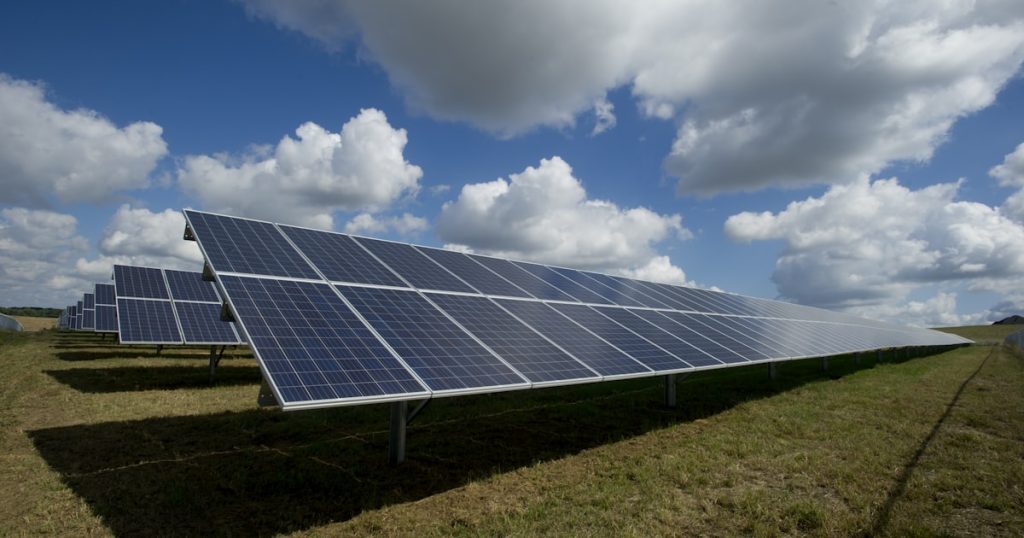
If hydro is Brazil’s foundation, solar is its revolution. Brazil’s solar industry has exploded over the past five years, driven by falling equipment costs (Brazil imports the majority of its panels from China, benefiting from the global cost curve), favourable regulatory frameworks, and the country’s extraordinary solar irradiance — large parts of the northeast and centre-west are among the sunniest places on the planet.
In January 2026 alone, Brazil’s National Electric Energy Agency (ANEEL) recorded the commissioning of 11 new utility-scale solar photovoltaic plants, adding 509 MW of new capacity in a single month. For the full year 2026, ANEEL expects 9,142 MW of total new installed capacity additions — a 23.4% increase over 2025 — with solar projects representing nearly 70% of all new additions.
Brazil’s total installed electricity capacity reached 216,715 MW by January 2026, with solar and wind combined now approaching 30% of the generation mix. Combined solar and wind generation is forecast by the IEA to approach 200 TWh in 2026, up from just over 15% of total generation in 2022. This rapid ramp-up has surprised even optimistic analysts and has made Brazil one of the fastest-growing solar markets in the Western Hemisphere.
Wind Energy: A Northeastern Success Story
Brazil’s wind energy boom has been concentrated in the semi-arid Northeast — states like Ceará, Rio Grande do Norte, Piauí, and Bahia — where consistent trade winds blow reliably, transmission infrastructure has been built specifically for renewable energy, and land costs are relatively low. Northeast Brazil is home to some of the highest capacity factor wind farms in the world, with turbines regularly achieving 55–65% capacity factors, compared with 30–40% in many European locations.
This regional concentration of wind power has created economic benefits for some of Brazil’s historically poorer states, generating jobs, royalty revenues, and improved infrastructure. Wind farm royalties have funded schools, health posts, and road improvements in municipalities that previously had few economic prospects beyond subsistence farming.
Biofuels: Brazil’s Other Clean Energy Revolution
Brazil’s clean energy story is not limited to the power sector. The country is a global pioneer in liquid biofuels, a fact often overlooked in discussions focused on electricity. Brazil’s sugarcane ethanol industry — which has been operating at commercial scale since the 1970s — produces some of the lowest-carbon transport fuel on the planet, with lifecycle emissions roughly 90% lower than petrol on a like-for-like basis.
The country’s ethanol supply is forecast to average 660,000 barrels per day (kb/d) in 2026, up substantially from 2020 levels. The domestic blending mandate requires all petrol sold in Brazil to contain 27% ethanol, and a growing fleet of flex-fuel vehicles — which can run on any mixture of ethanol and petrol, up to 100% ethanol — gives consumers the option to use even more. When global oil prices rise, Brazilians simply fill up with more ethanol; when sugar prices fall, the blend shifts back toward petrol. It is a remarkably adaptive system that has insulated Brazil from some of the worst impacts of global oil price volatility.
On the biodiesel side, Brazil has steadily increased its blending mandate for diesel, which now stands at 12% biodiesel — a share set to rise to 15% in 2026 and 20% by 2030 under the Fuel of the Future Law enacted in 2023. This law also established the National Sustainable Aviation Fuel Program (ProBioQAV), targeting the decarbonisation of Brazil’s aviation sector through domestically produced sustainable aviation fuels (SAF).
Taken together, biofuels mean that Brazil’s total primary energy supply was 50% renewable in recent years — an extraordinary achievement for a country of 215 million people with a diversified industrial economy. For context on country energy profiles globally, almost no large economy comes close to this renewable share of total energy.
The Fuel of the Future Law and Policy Framework
Brazil’s energy transition is not happening by accident. A series of policy frameworks have deliberately channelled investment into clean energy. The Fuel of the Future Law (Lei 14.993/2023) is the most comprehensive recent piece of legislation, establishing mandatory targets and incentive programmes across biofuels, biomethane, green hydrogen, and sustainable aviation fuels. The National Programme for Biomethane (incentivising the use of biogas from agricultural and urban waste) and the National Green Diesel Programme (promoting second-generation biodiesel) are both active and drawing private investment.
On electricity, Brazil’s auction system for renewable capacity — run by ANEEL and EPE — has been one of the most effective in the world at driving down prices through competitive tendering. Brazil routinely achieves record-low auction prices for solar and wind power, with some recent auctions clearing at prices equivalent to $20–25/MWh — among the cheapest clean electricity procurement prices recorded anywhere globally.
Challenges: Grid Integration, Transmission, and Social Equity
Despite its impressive headline numbers, Brazil’s energy transition faces real challenges. The rapid deployment of solar and wind — concentrated in specific regions — has created transmission bottlenecks that limit how much renewable power can actually reach Brazil’s major consumption centres in São Paulo, Rio de Janeiro, and the industrial south. Solving these transmission constraints requires billions of dollars in high-voltage lines and grid upgrades, investments that are planned but will take years to execute.
There are also social equity dimensions. Energy poverty remains a real challenge in Brazil, with approximately 1.5–2 million households still lacking reliable electricity access, mostly in remote Amazonian and rural communities. The government’s Luz para Todos (Light for All) programme has made progress, but the last mile of energy access remains difficult. Distributed solar, mini-grids, and off-grid solutions are increasingly seen as the path to universal access in these communities.
Climate risk is another structural concern. As noted above, the reliance on large hydropower makes Brazil’s electricity system vulnerable to droughts that are becoming more frequent and severe as climate change accelerates. The irony is that Brazil needs to deploy more solar and wind partly as insurance against the climate impacts that are already affecting its existing clean energy base.
Looking Ahead: COP30 and Global Influence
Brazil is set to host COP30 in Belém in November 2025 — the UN climate summit that will be a crucial checkpoint for global climate ambitions. Hosting COP30 has put Brazil’s energy leadership in the international spotlight and created political incentives to demonstrate continued progress on clean energy and deforestation reduction. The Brazilian government has committed to a 50% emissions reduction by 2030 and a target of net-zero by 2050.
Brazil’s energy model is already exerting global influence. The country’s expertise in flex-fuel vehicles has been exported to several other Latin American and African nations. Its auction-based approach to renewable energy procurement has been adopted as a model by regulators across the developing world. And its sugarcane ethanol industry is increasingly regarded as a template for second-generation biofuels that could be replicated elsewhere.
For those watching global energy trends, Brazil offers something increasingly rare: a large, industrialised economy that has already achieved near-total decarbonisation of its electricity sector and is rapidly expanding renewable energy both at home and as a model for others. The challenges are real, but so are the achievements.
Conclusion: A Model for the World, With Lessons for All
Brazil’s clean energy story is not just an inspiring statistic. It is a demonstration — at the scale of a continent-sized country with 215 million people and a complex industrial economy — that renewable energy can be the backbone of a modern electricity system. The IEA’s projection of 95% renewable electricity by 2026 would make Brazil’s grid one of the cleanest of any major economy on Earth.
The combination of hydropower stability, explosive solar and wind growth, a world-leading biofuels industry, and a well-designed policy framework gives Brazil a genuine claim to being the global leader in energy transition execution. Challenges around grid integration, drought risk, and energy access remain real — but they are challenges of managing success, not managing failure.
As the world looks for models of how to move rapidly toward clean energy at scale, Brazil’s experience offers both inspiration and a practical roadmap.
Data sourced from the International Renewable Energy Agency (IRENA), International Energy Agency (IEA), Brazil’s National Energy Research Office (EPE), and ANEEL. All capacity figures as reported to January 2026.


