

America’s Power Grid Under Pressure: How AI Data Centres Are Reshaping US Electricity Demand in 2026
The United States power grid is facing a moment of transformation unlike anything seen in a generation. After more than two decades of essentially flat electricity demand — a period when efficiency gains in lighting, appliances, and industry roughly offset population and economic growth — consumption is rising sharply again. The driving force is not a new industrial revolution in steel or chemicals, as in previous eras, but the voracious appetite of artificial intelligence infrastructure: data centres that run continuously, draw enormous quantities of power, and are being built at a pace that is straining the grid’s capacity to keep up.
In 2026, the consequences of this shift are becoming visible in higher electricity bills, grid reliability warnings, and a race between utilities, regulators, and developers to build generation and transmission fast enough to prevent the lights from flickering. For American consumers and businesses, the question is no longer whether electricity costs will rise — they will — but how high, how fast, and whether the grid can stay reliable as the energy landscape changes underneath it.
The Numbers: What AI Is Doing to US Power Demand
Total US electricity consumption reached approximately 4,082 billion kilowatt-hours (kWh) in 2024, the highest on record at the time. In 2026, the US Energy Information Administration (EIA) projects consumption will reach around 4,239 billion kWh — an increase of nearly 4% over two years, a pace of growth not seen since the early 2000s.
The single largest driver of new demand is data centres. By 2026, US data centre demand for electricity has reached 75.8 GW when accounting for IT equipment, cooling, lighting, and ancillary uses. To put that in perspective, 75.8 GW is roughly equivalent to the entire power consumption of Germany. And unlike the diffuse, weather-dependent demand of households, data centre load is largely constant, 24 hours a day, 365 days a year — the most demanding type of customer a power grid can have.
Goldman Sachs has estimated that approximately $720 billion will need to be invested in grid upgrades through 2030 to accommodate this growth. BloombergNEF projects US data centre power demand could reach 106 GW by 2035 if AI adoption trajectories hold. The EIA itself has forecast the strongest four-year growth in US electricity demand since 2000, driven primarily by large loads including data centres.
Electricity Prices Rising Across the Country
For American households, the trend in electricity prices is unmistakably upward. The EIA forecasts residential electricity prices rising from 17.29 cents per kWh in 2025 to 18.02 cents per kWh in 2026 — a 4.2% increase that will push the average American household’s annual electricity bill higher by roughly $60–80.
But averages conceal wide regional variation. New England, perennially among the most expensive markets in the country, averages around 30 cents per kWh in 2026 — nearly double the national mean and a reflection of limited pipeline capacity for natural gas, high reliance on imported electricity, and an ageing generation fleet. The Pacific region averages approximately 24.88 cents per kWh, elevated partly by California’s aggressive decarbonisation mandates and the associated infrastructure costs.
Texas, home to the Electric Reliability Council of Texas (ERCOT) grid, faces particularly acute pressures. Wholesale electricity prices in ERCOT are forecast to rise sharply in 2026, driven by a projected 45% increase at the ERCOT-North pricing hub. High demand, relatively thin reserve margins, and the concentration of data centre development in the Dallas-Fort Worth corridor have made Texas electricity markets among the most volatile in the country. The state experienced a catastrophic grid failure during the February 2021 winter storm, and while significant investments have been made since then, regulators and analysts remain watchful about summer 2026 peak periods.
Grid Reliability: Elevated Risk Warnings
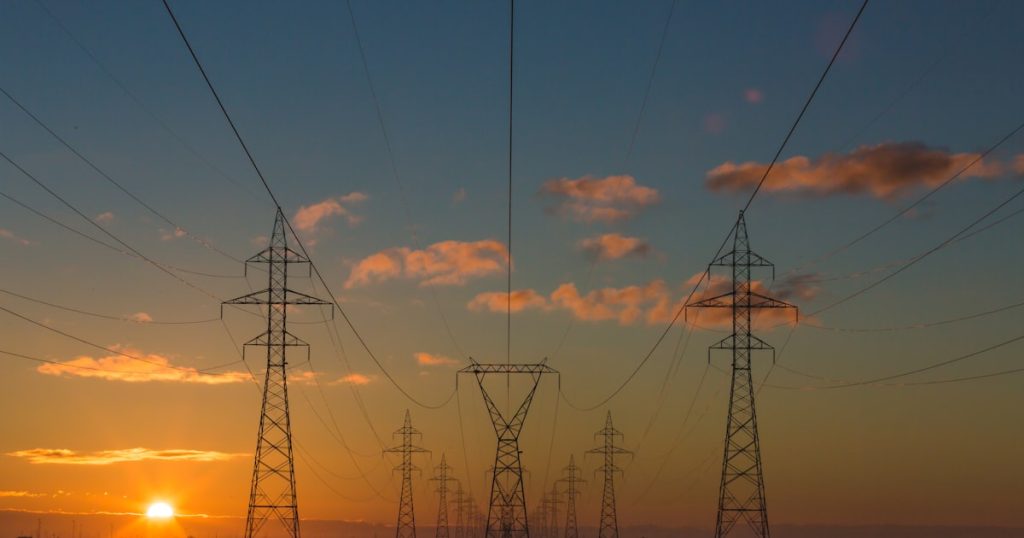
The North American Electric Reliability Corporation (NERC), which oversees grid reliability across the continent, has issued stark warnings about elevated risk of electricity shortfalls in multiple regions this year and in coming summers. PJM Interconnection — the largest US grid operator, serving over 65 million people across 13 states from Illinois to the Mid-Atlantic — projects it will be a full six gigawatts short of its reliability requirements by 2027.
The causes are interconnected. Coal and gas plant retirements are accelerating as older units become uneconomic in competitive wholesale markets. Nuclear plants face mounting operational costs. And while new renewable generation is being built at a rapid pace, it cannot always be relied upon during peak demand periods — solar panels produce nothing at night, and wind turbines fall silent when the air is calm, precisely the calm, hot evenings when summer air conditioning demand peaks.
PJM’s capacity auctions — the mechanism through which the grid procures the power needed for reliability — have seen prices surge dramatically in recent years as generators demand higher compensation for remaining available. This is another vector through which rising grid costs flow through to consumers and businesses, as capacity costs are ultimately recovered through utility bills.
The Renewable Build-Out: Progress and Bottlenecks
Against this backdrop of rising demand and grid stress, the US renewable energy sector is expanding at unprecedented speed. Renewable energy generation is expected to grow from 23% of total US electricity generation in 2024 to 27% by 2026 — a meaningful increase driven by continuing buildout of utility-scale solar and wind farms.
Solar installation has become extraordinarily cost-competitive: utility-scale solar in the United States now routinely costs less than $1 per watt to build, and the levelised cost of electricity from new solar farms is below that of new natural gas plants in most regions. Wind power has similarly matured into one of the lowest-cost generation sources available. The challenge is not generating capacity — it is grid integration.
Transmitting electricity from where renewables are most abundant (the windy plains of the Midwest, the sunny deserts of the Southwest) to where it is consumed (coastal cities, industrial centres, data centre clusters) requires massive investment in high-voltage transmission lines. Permitting and building transmission infrastructure in the United States takes a decade or more in many cases, involving multiple federal, state, and local regulatory bodies, landowner negotiations, and environmental reviews. The transmission bottleneck is increasingly seen as the binding constraint on the energy transition — not technology, not finance, but the slow machinery of American permitting.
The federal government has taken steps to accelerate permitting through provisions in the Inflation Reduction Act and subsequent executive actions, but the full effects of these reforms will take years to materialise in new transmission in service.
Natural Gas: Squeezed Between Growing Demand and LNG Exports
Natural gas remains the backbone of the US electricity system, supplying around 40% of generation in most years. But the gas market itself is being pulled in multiple directions simultaneously. Domestic electricity demand from data centres and other large loads is increasing gas consumption in the power sector. Meanwhile, LNG export capacity has expanded rapidly as terminals on the Gulf Coast and East Coast ship US gas to Europe, Asia, and Latin America — removing molecules from the domestic market and supporting higher prices.
The EIA forecasts Henry Hub natural gas prices averaging $4 per million British thermal units (MMBtu) in 2026, up from lower levels in recent years. Higher gas prices translate directly into higher electricity prices for the roughly 40% of US generation that comes from gas-fired power plants. For more on US gas markets, see our detailed analysis of Henry Hub volatility and the LNG export boom.
The Nuclear Option: A Growing Conversation
Amid the grid reliability concerns and rising demand, nuclear power has experienced a remarkable reputational rehabilitation in the United States. Several major technology companies — including those operating the largest data centre portfolios — have announced agreements to purchase electricity from nuclear plants or to fund the development of new nuclear capacity, including advanced small modular reactors (SMRs).
The logic is straightforward: nuclear provides firm, zero-carbon electricity around the clock — exactly what data centres need. The restart of Three Mile Island Unit 1 (now branded Crane Clean Energy Center) in Pennsylvania in 2024, powered by a long-term power purchase agreement with a major technology company, was a landmark moment signalling that nuclear could be commercially viable in the competitive US electricity market given the right contracts. Additional deals of this type are expected as large technology companies seek to meet their carbon commitments while securing reliable power for their infrastructure.
What American Consumers and Businesses Should Expect
The picture for 2026 and beyond is one of structurally higher electricity costs combined with continued investment in the infrastructure needed to support a growing, increasingly electrified economy. The US is adding electric vehicles to its roads, heat pumps to its homes, and industrial processes to its manufacturing base — all of which consume electricity. Data centres are simply the most visible and fastest-growing increment of new demand.
For households, the practical implication is rising bills — though the rate of increase will vary considerably by state and utility. For businesses with large electricity consumption, securing long-term power purchase agreements at today’s prices, investing in on-site generation and storage, and improving energy efficiency are all strategies worth serious consideration.
For tips on reducing your energy bills as electricity prices rise, see our How to Save section. And for the latest on energy news from across the US and globally, keep following our coverage.
Conclusion
America’s power grid is at an inflection point. The AI data centre boom has ended two decades of flat electricity demand, and the grid infrastructure built for a different era is struggling to keep pace. Higher prices, reliability concerns, and an urgent need for investment in generation and transmission define the US electricity landscape in 2026. The solutions — renewables, nuclear, storage, transmission, and demand efficiency — are available. The question is whether they can be deployed fast enough to meet a challenge that is growing by the day.


