
Saudi Arabia — the country most synonymous with oil — is undertaking a transformation of its domestic energy system. Under Crown Prince Mohammed bin Salman’s Vision 2030 plan, the kingdom has set an ambitious target of generating 50% of its electricity from renewable sources by 2030. This is not merely an environmental aspiration: the economics of domestic energy diversification are compelling for a country that currently burns significant quantities of oil in power plants, oil that could otherwise be exported at global market prices. The push to solar and wind is as much a fiscal strategy as a green one.
The Economic Logic
Saudi Arabia consumes approximately 3.5–4 million barrels of oil equivalent per day for domestic energy needs, including electricity generation, industrial processes, and desalination. A significant portion of this is oil burned in power plants — oil that has an international market value of $75–$80 per barrel. Every barrel replaced by solar or wind electricity saves Saudi Aramco and the government the opportunity cost of that oil, which can instead be exported. At current prices, this “opportunity cost” argument suggests domestic renewable investment has compelling returns even before any green credentials are counted.
Saudi Arabia’s electricity demand is also growing rapidly. Air conditioning accounts for the majority of residential electricity use in the kingdom, driven by extreme summer temperatures and a rapidly growing, increasingly affluent population. New cities, industrial zones, and the NEOM megaproject — the kingdom’s futuristic city-building programme — will add enormous amounts of new electricity demand over the coming decade. Meeting this demand from renewables rather than oil is central to the energy strategy.
Solar Projects: NEOM and NEON
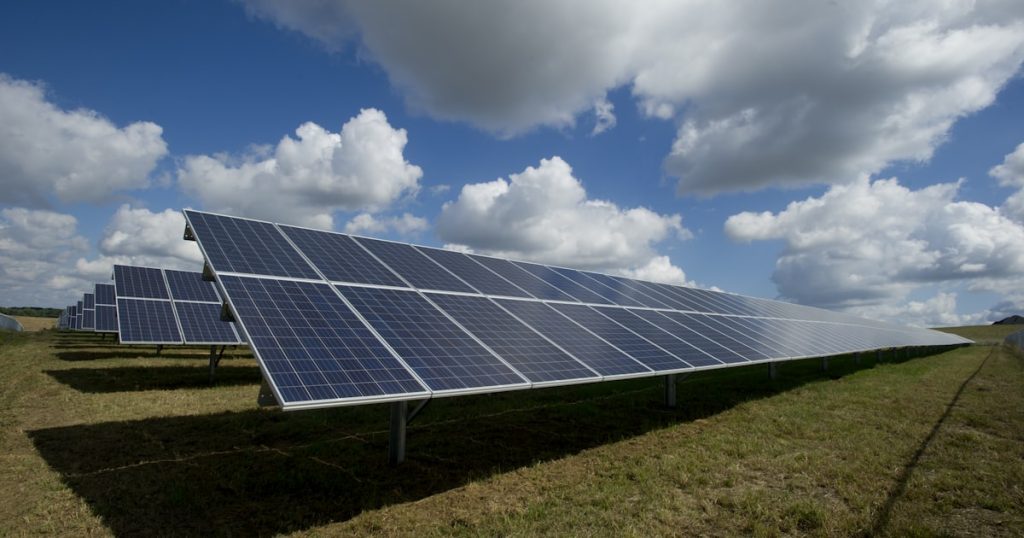
Saudi Arabia benefits from some of the highest solar irradiance in the world. The Arabian Peninsula receives intense year-round sunlight, and the geographic conditions are ideal for large-scale solar installations. The kingdom has begun deploying utility-scale solar at significant scale, with projects including the 2.6 GW Sudair Solar Energy Plant near Riyadh — one of the largest in the Middle East — and the Al Shuaiba solar project in the Makkah region.
The NEOM project, Riyadh’s flagship Vision 2030 initiative in northwestern Saudi Arabia, envisions an entirely renewable-powered megacity. NEOM’s energy requirements — for the planned Oxagon industrial city, the Sindalah island resort, and the ambitious linear city called “The Line” — are enormous, and the project has contracted significant solar and wind capacity. Whether NEOM’s ambitious plans are realised on the announced timescale remains to be seen, but the associated energy infrastructure investment is real and substantial.
Wind Energy Emerges
Wind has historically been less developed in Saudi Arabia than solar, but the kingdom’s northwest has significant wind resources. The 400 MW Dumat Al Jandal wind farm — the first utility-scale wind project in Saudi Arabia — reached full commercial operation in 2023, operated by EDF Renewables and Masdar. Several further wind projects are in development, and Saudi Arabia’s Vision 2030 targets include 16 GW of wind capacity by 2030 alongside 58 GW of solar.
The Saudi Power Procurement Company (SPPC) has been running competitive auctions for renewable capacity, attracting bids from international developers. Auction results have demonstrated the competitive economics of renewables in the kingdom, with solar prices in recent tenders coming in below $20/MWh — very low by global standards, reflecting the exceptional solar resource, low financing costs backed by sovereign support, and the scale of projects being developed.
Green Hydrogen: An Export Ambition
Saudi Arabia’s renewable push is not limited to domestic electricity. The kingdom has positioned itself as a future exporter of green hydrogen — produced by using renewable electricity to split water into hydrogen and oxygen via electrolysis. The NEOM Green Hydrogen Project, a joint venture involving ACWA Power, Air Products, and NEOM, is targeting production of 600 tonnes per day of green hydrogen, initially for export as green ammonia to global markets.
The IRENA has identified Saudi Arabia as one of the most cost-competitive potential green hydrogen production locations globally, given its solar resources and available land. Green hydrogen could eventually represent a new export revenue stream for a kingdom seeking to reduce its oil dependence, though the technology, infrastructure, and market development required means significant commercial hydrogen trade remains a medium-to-long-term prospect.
Challenges: Implementation and Pace
Saudi Arabia’s renewable ambitions face real implementation challenges. The kingdom’s domestic energy sector has been structured around subsidised fossil fuels for decades, and the institutional and regulatory frameworks for large-scale renewable procurement are relatively new. Permitting, grid connection, and supply chain development are all areas where capacity needs to be built.
The pace of deployment has been slower than the targets suggested in 2019–2020. Several major projects have experienced delays, partly attributable to the COVID-19 pandemic’s disruption of global supply chains and financing, and partly to the natural learning curve of establishing a new sector. The kingdom’s electricity regulator and Saudi Aramco, which has interests in both the oil status quo and the renewable future, are navigating complex institutional dynamics. Follow developments in global renewables and Middle East energy news on our site.
Strategic Significance
Saudi Arabia’s renewable push matters beyond its borders. As the world’s swing oil producer and the de facto leader of OPEC+, Saudi Arabia’s long-term energy strategy signals something about its assessment of oil’s future. A country betting heavily on domestic energy diversification — even while maximising oil export revenues today — is implicitly acknowledging that the era of oil may eventually transition. That signal, from the kingdom at the centre of the global oil market, is itself significant for how energy markets and investors think about the long-term future of hydrocarbons.


