
The Middle East has long been synonymous with oil and gas — the region supplies roughly a third of the world’s crude oil and hosts some of the planet’s largest natural gas reserves. But in 2026, a quieter and arguably more significant revolution is underway beneath the desert sun. From the UAE’s record-breaking solar farms to Saudi Arabia’s gigantic giga-projects and Oman’s rapidly expanding clean energy portfolio, the Gulf is emerging as an unlikely but formidable force in global renewable energy. The numbers involved are staggering, the geopolitical motivations complex, and the implications for global energy markets profound.
Why the Gulf Is Embracing Solar — and Why Now
The logic driving Gulf state investment in solar and renewable energy is multilayered. At the most basic level, abundant sunshine is an unrivalled natural advantage. Countries like the UAE, Saudi Arabia, and Oman receive between 2,000 and 3,000 hours of direct sunlight annually, with solar irradiance levels among the highest on earth. This translates into extraordinarily low levelised costs of electricity (LCOE) from solar photovoltaic (PV) projects — costs that have repeatedly broken global records in recent years.
Beyond the resource advantage, there is a compelling economic logic. Gulf governments subsidise electricity heavily for domestic consumers and industry. Every unit of solar electricity generated domestically displaces either gas or oil that could instead be exported at world market prices — a form of “avoided cost” that makes solar genuinely cheap even before accounting for carbon. Saudi Arabia, for instance, has historically burned significant quantities of crude oil in power stations during peak summer air conditioning season — an economically wasteful practice that solar can eliminate.
There is also the long-term economic diversification imperative. All Gulf Cooperation Council (GCC) states are acutely aware that their economies must evolve beyond hydrocarbon dependency. Developing world-class renewable energy industries — with associated manufacturing, engineering, and technology export potential — is central to Vision 2030 in Saudi Arabia, the UAE’s Net Zero by 2050 strategy, and similar frameworks across the region.
The UAE: Setting Solar Records
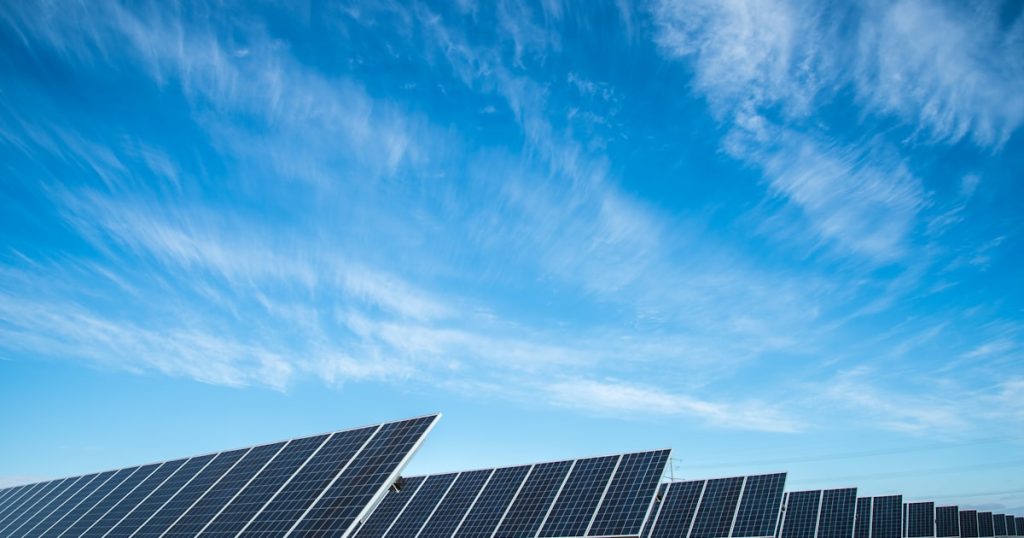
The UAE has established itself as arguably the most advanced renewable energy market in the Arab world. The country’s flagship project, the Mohammed bin Rashid Al Maktoum Solar Park (MBR Solar Park) on the outskirts of Dubai, is targeting a total capacity of 5 gigawatts (GW) by 2030 and is already one of the world’s largest single-site solar installations. Phase 5 of the project, using thin-film cadmium telluride technology supplied by First Solar, added 900 megawatts (MW) in 2023-2024, contributing to the park’s growing output.
Even more striking is the Al Dhafra Solar PV project in Abu Dhabi, developed by a consortium including TAQA, Masdar, EDF, and JinkoPower. With a nameplate capacity of 2.1 GW, Al Dhafra is among the world’s largest single-site solar plants. When it was awarded, the project set a world record for the lowest solar electricity bid price — reportedly around USD 0.013 per kilowatt-hour (kWh) — demonstrating the extreme competitiveness of solar in high-irradiance desert environments.
Abu Dhabi’s clean energy company Masdar — a subsidiary of Abu Dhabi National Energy Company (TAQA), Mubadala, and ADNOC — has become one of the world’s most active renewable energy developers, with a portfolio spanning more than 40 countries and a target of 100 GW of renewable capacity globally by 2030. Masdar is active across solar, wind, green hydrogen, and floating offshore wind, making it a genuinely global clean energy player rather than a purely domestic operator.
The UAE is also host to the Arab world’s first operational nuclear power plant. The Barakah Nuclear Energy Plant in Abu Dhabi, built by Korea Electric Power Corporation (KEPCO) under a landmark contract awarded in 2009, now has all four of its APR-1400 reactors operational, providing approximately 5.6 GW of zero-carbon baseload electricity — around a quarter of the UAE’s total power needs. Together, nuclear and solar are rapidly decarbonising the UAE’s electricity grid. For more on how renewable energy is transforming power markets globally, see our dedicated renewables coverage.
Saudi Arabia: Vision 2030 and the 50% Renewable Target
Saudi Arabia’s renewable energy ambitions are vast in scale, even if execution has been slower than originally envisaged. Under Vision 2030 — Crown Prince Mohammed bin Salman’s sweeping economic modernisation agenda — the Kingdom has set a target of generating 50% of its electricity from renewable sources by 2030, up from under 5% today. Achieving that target in just four years would require adding tens of gigawatts of solar and wind capacity at a pace the country has yet to demonstrate.
The Saudi Power Procurement Company (SPPC) has tendered multiple utility-scale solar projects in recent years. The Al Shuaibah Solar PV project, at 2.6 GW, is one of the largest awarded, with Saudi Aramco’s energy subsidiary ACWA Power as the lead developer. ACWA Power — majority owned by the Saudi government’s Public Investment Fund (PIF) — has emerged as the dominant renewable energy developer across the MENA region, with projects in Saudi Arabia, the UAE, Egypt, Uzbekistan, and beyond. The company’s model of developing, owning, and operating renewable energy assets at scale across emerging markets makes it a significant player in the global energy transition.
NEOM — the $500 billion futuristic city project being constructed in northwest Saudi Arabia — is designed to run entirely on renewable energy. The NEOM Green Hydrogen Company joint venture with ACWA Power and Air Products is developing a 4 GW electrolyser facility powered by wind and solar, designed to produce green ammonia for export. This project, one of the world’s largest planned green hydrogen facilities, is a bellwether for whether Gulf states can monetise their renewable resources beyond domestic electricity generation.
Saudi Arabia is also developing significant wind capacity. The Dumat Al Jandal wind farm — the Kingdom’s first commercial wind project, with 328 MW capacity — became operational in 2023. Further wind projects in the northwest of the country, where wind resources are stronger, are in planning and tendering stages. For context on how Saudi Arabia’s oil output decisions interact with its domestic energy strategy, our oil prices section covers OPEC+ dynamics and their market implications.
Across the Gulf: Oman, Qatar, Kuwait, and Bahrain
Saudi Arabia and the UAE are not alone in the Gulf’s solar push. Oman has set a target of 30% renewable energy by 2030 and is making measurable progress. The 500 MW Ibri II solar project — one of the region’s largest — reached commercial operation in 2021, and the Manah I and Manah II solar projects, totalling 1 GW, are under construction. Oman’s relatively smaller economy and oil revenues give it a stronger incentive to build out domestic renewables quickly to reduce the opportunity cost of burning gas and oil at home.
Qatar, despite its vast LNG wealth, is also investing in solar. The 800 MW Al Kharsaah Solar PV Power Plant — developed by ACWA Power and Total Eren — has been operational since 2022 and supplies around 10% of Qatar’s peak electricity demand. Given that Qatar hosted the 2022 FIFA World Cup with promises of sustainable infrastructure, the Al Kharsaah project has been a high-profile element of the country’s green credentials.
Kuwait and Bahrain have made slower progress but both have renewable energy targets and active tender processes. Kuwait’s Al-Dibdibba solar project — planned at 1.5 GW — has faced repeated delays but remains in the pipeline. Bahrain, as the smallest Gulf economy, faces particular challenges of limited land and high electricity demand relative to size.
Green Hydrogen: The Next Frontier
Beyond electricity, Gulf states are positioning themselves to become major exporters of green hydrogen — made by using renewable electricity to split water into hydrogen and oxygen via electrolysis. The strategic logic mirrors their existing energy export model: use abundant natural resources (sun and wind instead of oil and gas) to produce an energy carrier that can be shipped globally.
Green hydrogen and its derivatives — green ammonia, green methanol, synthetic fuels — are seen as key to decarbonising hard-to-electrify sectors like shipping, steel, fertilisers, and aviation. The Gulf’s competitive advantages in renewable electricity costs, existing export infrastructure, and geopolitical relationships with European and Asian energy importers give it a credible shot at becoming a significant green hydrogen supplier by the 2030s.
International organisations including the International Renewable Energy Agency (IRENA) — headquartered in Abu Dhabi — project that the Middle East and North Africa region could supply up to 12% of global traded green hydrogen by 2050, representing a multi-hundred-billion-dollar industry. The region’s combination of ultra-low solar costs, available land, and proximity to major demand centres in Europe and Asia positions it uniquely for this opportunity.
Challenges Ahead: Grid, Finance, and Execution
The Gulf’s renewable ambitions are real and backed by significant capital, but challenges remain. Grid infrastructure in many Gulf states needs substantial upgrading to integrate large volumes of variable solar and wind generation. Interconnection between GCC countries — which would allow renewable surpluses in one country to supply deficits in another — is limited, though a regional grid upgrade project is being discussed.
Water use is another consideration. Utility-scale solar panels in desert environments require periodic cleaning, and in a water-scarce region, this demands careful management. Robotic dry-cleaning systems are being deployed at scale to reduce water consumption, but the challenge grows as installation volumes increase.
Financing and execution capacity are also factors. Many of the largest announced projects have faced delays in financial close, procurement, or construction. Ambition, as Saudi Arabia’s slow progress towards its 50% renewable target illustrates, does not always translate directly into operational capacity on schedule.
Conclusion: A New Chapter for a Region Defined by Oil
The Middle East solar revolution is not a replacement for the region’s oil and gas industries — those will remain central to Gulf economies for decades. But it represents a genuine and accelerating diversification of the energy base, driven by compelling economics, long-term strategic logic, and the imperative of maintaining prosperity beyond the oil age. With record-low solar costs, world-leading project developers, and sovereign wealth funds willing to deploy capital at scale, the Gulf is writing a new chapter in global energy — one that will matter far beyond the desert. For broader analysis of global energy market developments, our news coverage tracks the trends shaping this fast-moving transition.


